

Where VERANI begins
VERANI took its name in 1896. The family's work is older. By the close of the nineteenth century, the Veranis had worked fine leathers for generations; in that year, the work was placed under the family name, and the standard set under that name has not moved since.
The House did not pursue scale. It refused the two paths open to it — expansion and imitation — and built instead a network: tanneries, weavers, and a small number of workshops whose names were known only to the trade. Several of these have supplied the House without interruption for over a century.
The Arabic sandal
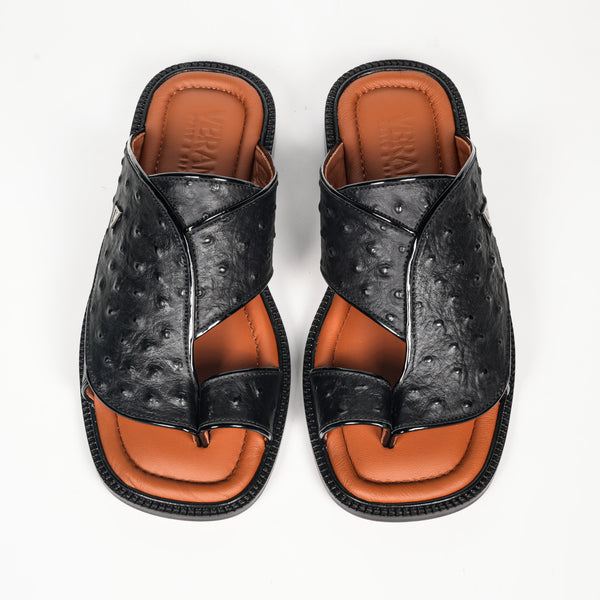
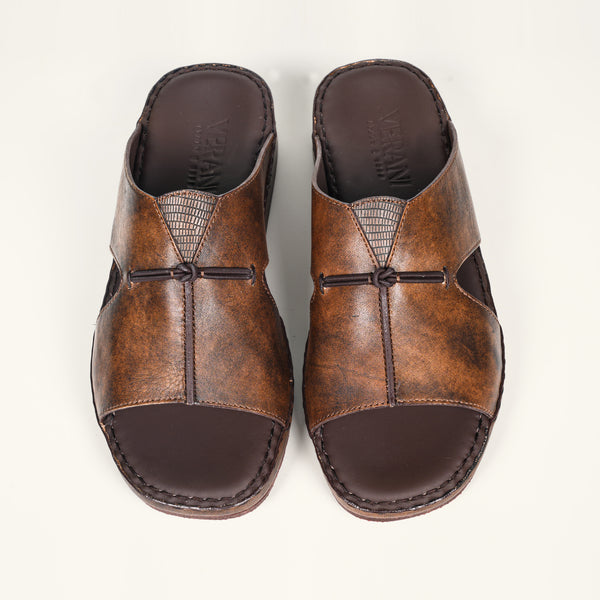
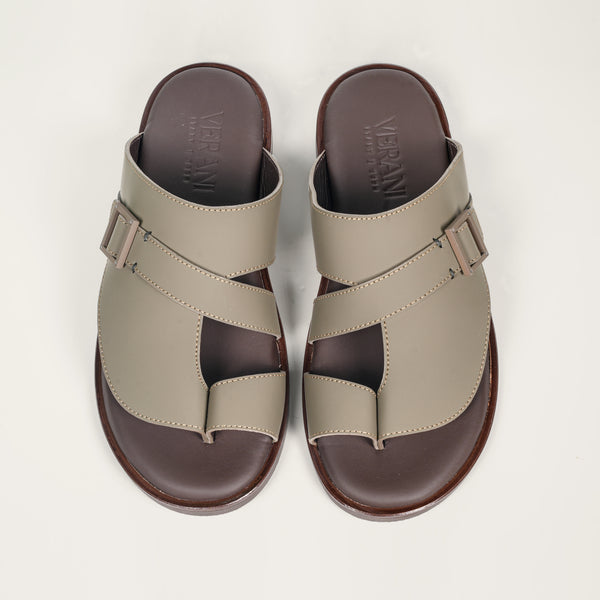
The House's signature work is the Arabic sandal — the sandal of the Gulf, worn with the dishdasha and the thobe, from the majlis to occasions of state. VERANI makes this form to Italian standards: full-grain leathers, hand finishing, and each pair individually numbered.
The Arabic sandal is among the oldest continuously worn forms of footwear in the world. VERANI treats it accordingly — not as a fashion object but as a form with codes, refined rather than reinvented.
Arabia
The House's first formal presence across Arabia began in 1958. By 1975, its work extended through Oman, the Emirates, Bahrain, Qatar, Kuwait and Saudi Arabia.
It did not enter Arabia to make noise. It entered to understand proportion, dress, climate, protocol and use. The cut of the dishdasha, the weight of cloth, the etiquette of the majlis, the restraint expected at formal occasions — these were not decorative references. They were conditions the work had to answer.
The House has stood behind collections, manufacturers and houses across the Gulf. It does not name its clients, and it does not explain itself. Discretion, in the House's view, is a construction standard: it either holds or it does not.
For decades, VERANI stood behind collections, makers and houses across the Gulf. The names were known. The hand was not credited. The House preferred it this way.
The standard
Every VERANI piece is cut, finished and numbered to the standard set in 1896. A material enters the House only after it has been proven; a construction is adopted only when the previous one has been exhausted. The standard has not moved, and it will not.